
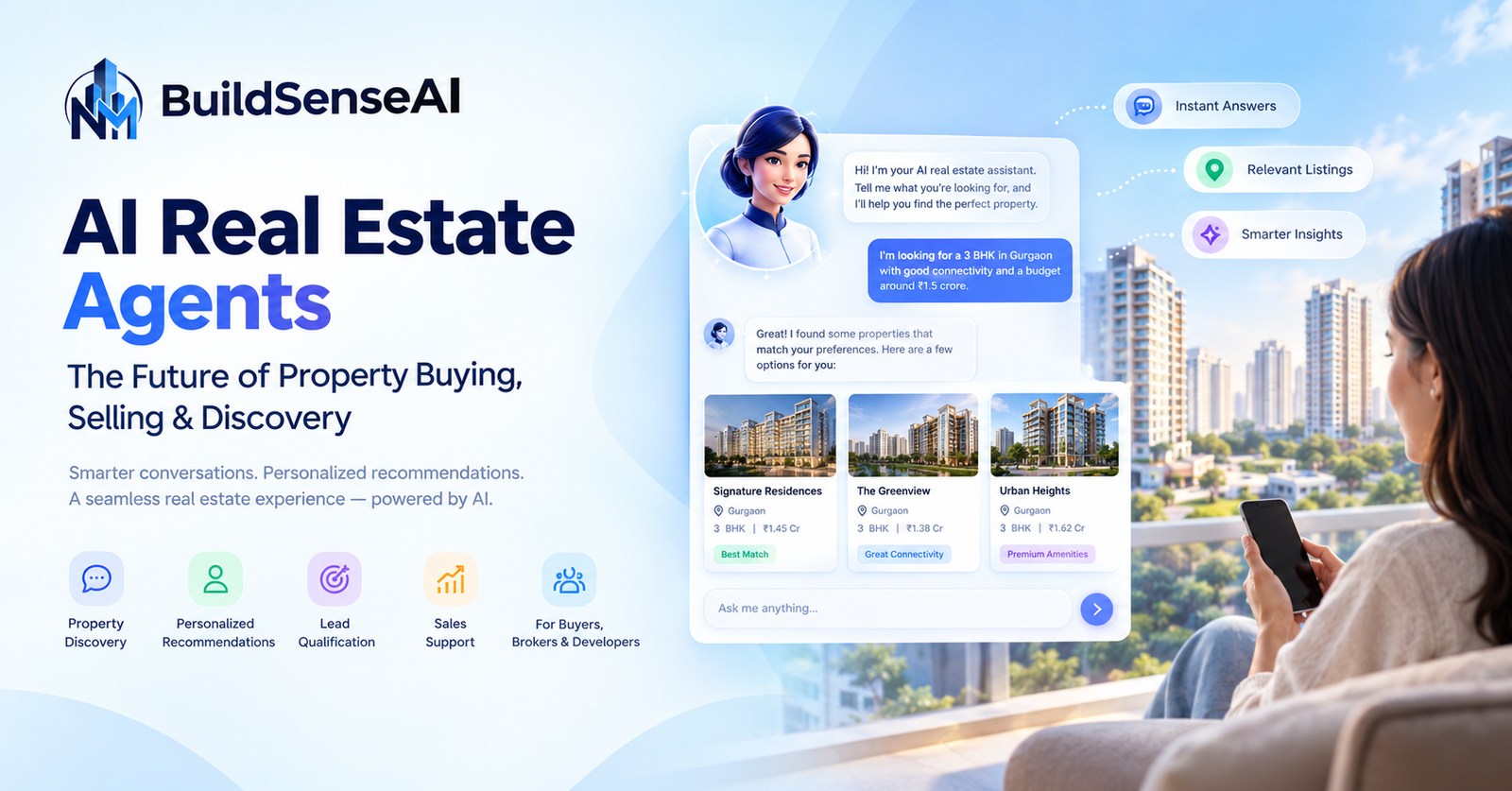
"Discover how AI real estate agents are transforming property search, customer engagement, lead qualification, recommendations, and sales for the modern real estate industry."
AI Real Estate Agents: How Artificial Intelligence Is Transforming Property Buying and Selling
The real estate industry is entering a new era—one where artificial intelligence can move beyond automation and become an intelligent layer connecting property data, customers, developers, brokers, and sales teams.
For decades, real estate has fundamentally been a relationship-driven business. People rely on brokers, sales representatives, developers, property consultants, and other professionals to help them make one of the most important financial decisions of their lives. Technology has already changed how properties are listed, searched, marketed, and managed, but much of the actual experience remains fragmented.
A customer may discover a property on one platform, look for project information on another, speak to a sales representative over WhatsApp, compare options manually, and then wait for someone to answer questions about availability, configuration, pricing, or possession. At the same time, developers and sales teams are managing large amounts of information across CRMs, spreadsheets, inventory systems, communication platforms, and internal processes.
Artificial intelligence has the potential to change this experience fundamentally.
The emergence of AI real estate agents means technology can move beyond simply displaying information and begin helping people understand, discover, compare, and act on that information. Instead of requiring customers to navigate complex property databases, an AI agent can understand what they are looking for and guide them through the discovery process using natural conversation.
At BuildSenseAI, we believe this is an important step toward a more intelligent real estate ecosystem.
What Is an AI Real Estate Agent?
An AI real estate agent is an intelligent software agent designed to assist users with real estate-related tasks using artificial intelligence. Unlike a traditional chatbot that relies primarily on predefined responses, an AI agent can be designed to understand the context behind a conversation, identify user intent, work with structured property information, and provide more relevant responses.
Imagine a prospective buyer saying, "I'm looking for a 3 BHK in Gurgaon for my family. My budget is around ₹1.5 crore, and I want something with good connectivity and amenities." A traditional property platform might ask the customer to enter each requirement into a series of filters. An AI agent can instead understand the request as a complete requirement and continue the conversation naturally.
It could ask about preferred locations, possession timelines, family requirements, or other priorities before helping narrow down the available options. As the conversation progresses, the agent can build a better understanding of what the customer actually needs rather than treating every search as a collection of disconnected filters.
This changes the role of technology from being a property database to becoming an intelligent property assistant.
Why Real Estate Needs a More Intelligent Digital Experience
Real estate is particularly suited to AI because the industry generates enormous amounts of structured and unstructured information. Every project can have multiple configurations, unit types, prices, availability statuses, amenities, floor plans, locations, specifications, payment structures, possession timelines, and other details.
For a customer, however, this information is rarely useful in isolation.
A buyer doesn't necessarily want to know everything about every available property. They want to know which properties are relevant to their situation. An investor may care about completely different information from a family looking for a home. A first-time buyer may need explanations about configurations and financing, while an experienced investor may want to compare projects based on investment potential.
This is where traditional search experiences begin to show their limitations.
Most property platforms are designed around the question, "What properties are available?" The next generation of real estate technology can instead begin with a different question: "What does this customer actually need?"
That shift—from inventory-first experiences to intent-driven experiences—is one of the most important opportunities for AI in real estate.
From Property Search to Property Conversation
The traditional property search journey is largely based on filters. Customers select a location, choose a configuration, enter a budget, select amenities, and browse through the resulting listings. This works well when someone already knows exactly what they want, but real estate decisions are rarely that simple.
Many customers begin with an idea rather than a precise requirement. They may know the city they want to live in but not the exact locality. They may know their approximate budget but not which configurations are realistic within it. They may have a general preference for amenities without knowing which features are actually important for their lifestyle.
An AI real estate agent can make this process conversational.
A customer can explain their requirements naturally, and the agent can ask relevant questions to refine the search. Instead of forcing the customer to understand the platform's data structure, the technology adapts the experience around the customer's way of thinking.
This is a significant change in user experience. The customer doesn't need to know exactly what to search for. They simply need to explain what they are trying to achieve.
The AI then helps translate that intent into relevant property options.
Personalizing Property Recommendations With AI
Personalization is another major opportunity for AI in real estate. Two people searching for the same configuration in the same city may have completely different priorities.
Consider two customers looking for a three-bedroom apartment. One may be purchasing a home for a family with young children and prioritize schools, parks, security, and connectivity. Another may be an investor who cares more about rental demand, location growth, and potential returns.
A conventional search engine may show both customers largely the same inventory.
An intelligent system can potentially understand the difference.
By considering factors such as budget, location preferences, configuration, purpose of purchase, lifestyle requirements, timeline, and other stated preferences, an AI agent can help prioritize properties that are more relevant to the individual customer.
The objective isn't simply to show customers more listings. It is to reduce the distance between what a customer wants and the property that may actually fit those requirements.
That is where AI-powered recommendations can become particularly valuable.
AI-Powered Lead Qualification for Real Estate
The opportunity isn't limited to the buyer experience. AI can also fundamentally improve how developers and sales teams handle leads.
Real estate businesses often receive a large number of enquiries through websites, portals, advertising campaigns, social media, WhatsApp, phone calls, and other channels. Not every enquiry represents the same level of intent, and sales teams can spend significant amounts of time trying to understand basic customer requirements.
An AI agent can become the first intelligent layer in this process.
Rather than simply collecting a name and phone number, the agent can have a meaningful conversation with the prospect. It can understand the customer's preferred location, budget, configuration, purpose of purchase, timeline, and other requirements. This information can then provide sales teams with better context before a human representative enters the conversation.
For example, instead of receiving a generic lead saying "Interested in 3 BHK," a salesperson could receive a structured understanding of the conversation: the customer is looking for a three-bedroom home in a particular locality, has a defined budget range, is purchasing for end use, and expects possession within a certain timeframe.
The salesperson can then begin the conversation with context rather than starting from scratch.
AI therefore doesn't necessarily replace the salesperson. It can make the salesperson more informed and more effective.
AI Agents Can Support Developers Beyond Lead Generation
For real estate developers, AI has applications that extend well beyond marketing and lead generation.
Developers manage complex portfolios containing projects, inventory, configurations, pricing information, sales activity, channel partners, and operational data. As the portfolio grows, keeping all of this information organized and accessible becomes increasingly important.
An AI agent can act as an intelligent interface over this information.
A developer or sales representative could potentially ask questions such as:
"How many three-bedroom units are currently available?"
"Which configurations have the highest sold inventory?"
"What inventory is available in this project?"
"Which properties match this customer's requirements?"
Instead of navigating through multiple screens or searching through spreadsheets, users can interact with the information conversationally.
This is where the combination of structured real estate data and AI becomes particularly powerful.
AI doesn't create value simply because it can generate a response. Its real value comes from being able to provide useful responses based on accurate, relevant, and up-to-date business information.
The Importance of Real Estate Data
There is an important principle behind every successful AI experience:
Better intelligence requires better information.
Real estate is no different.
An AI agent may be capable of understanding a customer's request, but if the underlying inventory information is outdated or incomplete, the experience will still be unreliable. If a unit has already been sold but the system shows it as available, the customer experience suffers. If configuration information is inconsistent across systems, recommendations can become inaccurate.
This means the future of AI-powered real estate is not only about building sophisticated AI models. It also requires reliable infrastructure for managing the underlying real estate data.
Projects, inventory, configurations, partners, availability, and operational information need to be organized in a way that technology can use effectively.
This is one of the reasons we see the developer operating layer as an important part of the intelligent real estate ecosystem.
Where PropOS Fits Into the BuildSenseAI Ecosystem
At BuildSenseAI, we are approaching intelligent real estate from multiple sides.
PropOS is designed as a developer-facing operating platform that brings core real estate operations into one centralized environment. Developers can manage their projects, monitor inventory, view configurations, manage brokers and channel partners, complete their developer profile and verification, and access business-level visibility through dashboards and reports.
This operational foundation matters because intelligent experiences need reliable data underneath them.
Think of the ecosystem as three connected layers.
At the operational layer, developers need tools to manage their projects and inventory. PropOS helps bring this information together.
At the intelligence layer, AI can analyze information, understand context, identify patterns, and assist users.
At the experience layer, AI agents can make that intelligence accessible through natural conversations with buyers, brokers, sales teams, and other stakeholders.
The result is a connected approach where the systems managing real estate operations can eventually support the intelligent experiences interacting with customers.
AI Real Estate Agents and the Human Element
There is often a concern that AI will replace real estate professionals.
We believe the more meaningful opportunity is different.
Real estate is a high-value and highly personal industry. Buying a home is not simply a transaction. Customers may need advice, reassurance, negotiation support, market knowledge, financial guidance, and personal interaction before making a decision.
These are areas where human expertise remains extremely valuable.
AI can instead take care of the repetitive and information-heavy parts of the journey. It can answer common questions, understand initial requirements, organize information, qualify leads, identify relevant properties, and provide assistance outside traditional working hours.
Once a customer reaches a stage where human expertise matters most, the AI can help bring the right professional into the conversation.
This creates a human + AI model.
AI handles speed, scale, information, and repetitive interactions.
Humans bring trust, relationships, judgment, expertise, and negotiation.
Rather than replacing the real estate professional, AI can give that professional better tools.
AI for Brokers and Channel Partners
Brokers and channel partners are another important part of the real estate ecosystem.
A broker may work with multiple developers and dozens of projects, each with different configurations and inventory. Finding the right property for a specific customer can therefore require significant time and access to accurate information.
AI can simplify this process by helping brokers search and match inventory based on customer requirements.
A broker could potentially describe a customer's needs in natural language and receive relevant property options rather than manually checking multiple systems.
This can help brokers spend less time searching for information and more time doing what they do best—understanding customers, advising them, building relationships, and facilitating transactions.
For developers, better broker experiences can also mean more effective distribution of inventory through channel networks.
The Future of Property Discovery Will Be More Conversational
The next generation of property platforms may look very different from the listing websites people use today.
Instead of beginning with hundreds of properties and asking customers to filter them down, platforms can begin with a conversation.
A customer might say:
"I'm moving to Gurgaon next year. I need a three-bedroom home for my family. My office is in Cyber City, I have two children, and I'd like to stay within a certain budget."
An intelligent agent can use that information to understand the customer's situation. It can ask additional questions where necessary, identify relevant projects, explain why they may be suitable, and help the customer compare options.
The experience becomes less about searching through inventory and more about guided discovery.
This distinction matters because customers don't necessarily want access to every property.
They want help finding the right property for them.
From Automation to Intelligence
Real estate technology has already gone through several stages of transformation.
First, property information moved from offline listings into digital platforms. Then marketplaces made property discovery easier and allowed customers to compare a much larger selection of properties. CRM systems and workflow tools subsequently helped developers and sales teams organize their operations.
AI represents the next stage.
The opportunity is no longer simply to digitize an existing process. It is to make the process itself more intelligent.
Automation asks:
"How can we make this task faster?"
AI can ask:
"How can we understand what this person needs and help them achieve it?"
That difference is significant.
The future of PropTech will increasingly be about systems that don't just store information but understand the context around it and help people act on it.
What an Intelligent Real Estate Ecosystem Could Look Like
Imagine a future where a developer manages projects and inventory through a centralized operating platform. The same structured information can power intelligent customer experiences across websites, mobile applications, WhatsApp, sales interfaces, and broker platforms.
A customer interacts with an AI real estate agent and describes what they are looking for. The agent understands the requirement and identifies relevant inventory.
A broker can access the same intelligence to help match a customer's needs with available properties.
A sales representative receives the conversation context before speaking with the customer.
The developer can see how inventory is performing through operational dashboards and reports.
Instead of each stakeholder operating in a disconnected environment, information can flow across the ecosystem.
This is the kind of connected experience that can make real estate genuinely intelligent.
The BuildSenseAI Vision for Intelligent Real Estate
At BuildSenseAI, our vision goes beyond building another property portal or another software tool.
We believe real estate needs an intelligent technology layer that can connect the different participants in the ecosystem.
Developers need better operational visibility. Brokers need easier access to relevant inventory. Sales teams need better-qualified conversations. Customers need simpler and more personalized property discovery.
AI can become the connective layer between these needs.
PropOS represents the developer and operational side of this vision, providing a structured environment for projects, inventory, configurations, partners, and business information.
AI agents represent the intelligent interaction side, helping turn that information into useful conversations and experiences.
Together, these technologies can help move the industry from fragmented digital tools toward a more connected real estate ecosystem.
The Future of Real Estate May Begin With a Conversation
The way people interact with technology has changed dramatically.
We have moved from clicking through menus to searching with keywords, and now we are increasingly moving toward conversational interfaces.
Real estate is ready for the same transformation.
Instead of asking customers to understand how a property platform is organized, technology can understand how customers naturally describe their requirements.
Instead of making sales teams manually qualify every enquiry, AI can help organize and contextualize those conversations.
Instead of making brokers search through multiple sources of inventory, intelligent systems can help them find relevant options faster.
And instead of treating property information as static data, AI can turn it into an interactive experience.
This is the real opportunity behind AI real estate agents.
They aren't simply chatbots with a real estate theme.
They represent a shift toward intelligent, contextual, and personalized real estate experiences.
Conclusion: Building a More Intelligent Real Estate Industry
Artificial intelligence is changing the way businesses interact with customers, and real estate is entering an important stage of that transformation.
AI real estate agents can help make property discovery more conversational, recommendations more relevant, lead qualification more efficient, and information more accessible. For developers and brokers, they can reduce repetitive work and provide better context. For customers, they can make an often complicated property journey simpler and more personalized.
But intelligent real estate requires more than an AI interface.
It requires reliable data, connected systems, structured inventory, and an operational foundation that can support intelligent experiences.
That is why the future of real estate technology will likely be defined by the combination of data, operations, AI, and human expertise.
At BuildSenseAI, we are building toward that future.
With PropOS, we are creating an intelligent operating foundation for developers. With AI-powered real estate agents, we are exploring a new way for customers, brokers, sales teams, and developers to interact with property information.
The goal is not to remove the human element from real estate.
It is to make the entire ecosystem faster, smarter, more connected, and more helpful.
Because the future of real estate isn't just digital.
It's intelligent.
Interested in automating your real estate workflows?
Speak with BuildSense AI engineers to automate compliance, channel partner enablement, and sales velocity for your project portfolio.